







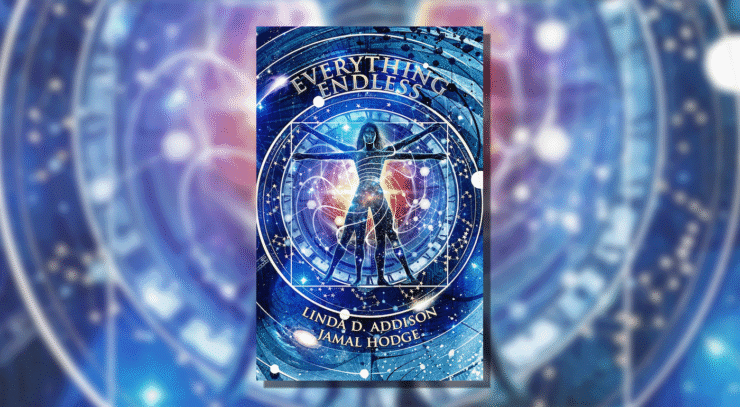
Welcome back to Reading the Weird, in which we get girl cooties all over weird fiction, cosmic horror, and Lovecraftiana—from its historical roots through its most recent branches. This week, we celebrate National Poetry Month with a 2025 Stoker nominated Linda D. Addison and Jamal Hodge’s Everything Endless, published in 2025. Spoilers ahead! (To the degree that that’s possible. It’s great, it’s short, and we recommend that you just go ahead and read the whole thing.)
I’m not going to attempt even a haiku-style synopsis of this week’s tribute to Poetry Month. Too many poems, too much going on, as one would expect (and hope for) in an exploration of All Time and Space, particularly one titled Everything Endless. For a concise overview, I borrow the blurb Bryan Thao Worra provided for the chapbook:
“[Everything Endless is] an ambitious collaboration engaging big ideas with compact verses, sprawling from modest corners to the outermost regions we imagine today. Sometimes mathematical, sometimes whimsical, at times terrifying and profound, this is a collection to be read closely with appreciation […] a fine model of what is possible with speculative poetry today.”
It’s divided into four sections:
“NO/BEGINNING” — Poems about beginnings, origins, first breaths, again and again and again, because can what is eternal in truth have a starting point?
“NO/END” — Poems about windings down, loss, futile endeavors, again and again and again, because can what is eternal in truth have an ending point?
“SEVEN/NOW” — What numbers seven here are foundational principles purportedly based on the teachings of Hermes Trismegistus. We the Weird will remember Hermes as one of those venerable sages whose tomes often appear in the libraries of dark wizards like Joseph Curwen. The Seven Hermetic Principles appear in The Kybalion (1908), which is attributed to “Three Initiates”—the primary author may be New Thought luminary William Walker Atkinson.
Addison and Hodge take turns riffing on the Seven:
- The Law of Mentalism: Reality is created by a universal mind.
- The Law of Correspondence: Planes of existences are connected, “harmonized.”
- The Law of Vibration: Nothing in the universe is still; everything “vibrates.”
- The Law of Polarity: Everything is dual, with poles of extremes, like dark and light.
- The Law of Rhythm: Everything flows, swings, as tides flow from high to low.
- The Law of Cause and Effect: Nothing happens by chance.
- The Law of Gender: Everything has both a masculine and a feminine aspect.
“END/LESS” — A single longer poem written by Addison and Hodge together. “Though You Always Are” is structured as a missive from “All Time and Space” to the “Dear Poets of the 21st Century on Spatial Location Sol III.” By the way, Dear Poets, a letter with authenticated signatures of Time and Space would bring in a mind-boggling price at any intergalactic and/or interdimensional auction. For a mere 10% fee on final proceeds, I’d be glad to arrange the transaction for you.
Buy the Book
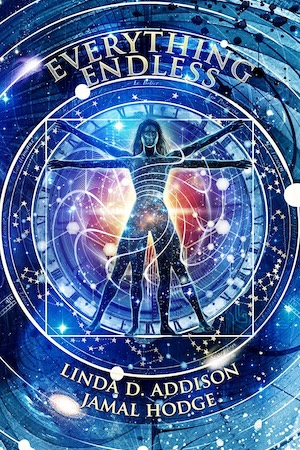
Everything Endless
What’s Cyclopean: The whole collection is full of languages of scale, from germ to black hole to the full arc of time.
The Degenerate Dutch: Can we get over our prejudices long enough to talk with aliens, or is the potential range of our ingroup/outgroup distinctions infinite?
Weirdbuilding: The thing that’s “beyond comprehension” is also “no more complicated than a fart.”
Anne’s Commentary
There are 44 poems in all, ranging from three short lines (Hodge’s “After”) to the 40-plus longish lines of the shared finale. Structurally, free and blank verse prevail. The “Seven/Now” section has the most formal feel of the four, with each poet contributing one relatively substantial poem on each Law of Hermetic philosophy, first Hodge, then Addison. The first two sections might be called “Our Very Long, Caffeine-Fueled Conversation in the Back Booth of the 24/7 Coffee Shop.” I can see myself sitting in the next booth over, eavesdropping and frantically scribbling notes all over the work I was supposed to be doing. As per the Law of Rhythm above, Addison and Hodge’s poems ebb and flow, flow and ebb, between inducing forehead-wrinkling concentration and suppressed laughter.
A good eavesdropper never tips off the eavesdroppees to her presence.
Two of my favorite poems, by Jamal Hodge, are “Generational Ships” and “Cryo Menu.” In my twisted mind, the pair tell the story of ships sent off from a no longer hospitable earth toward a parsecs distant new home, new start. The passengers dream in their cryogenic sleep, alive but deaf and blind to “the daily agony, this insanity,/of our collective breath.” Is such insensibility a blessing or a curse and terrible danger? The sleepers “go, never to arrive… live, never to know.” They will, in fact, “die, victims, of a forgotten hope.” Wait, what goes wrong?
“Cryo Menu” strikes me as the answer to that question. Among the humans aboard the generational ships is a “Space Vampire, in cryo-coffin.” It emerges from stasis “for a mid-light-year snack” and is “flabbergasted by the assortment of flavors on the deep space itinerary.” I fear the assorted flavors are the other passengers, who “continue to snore” while the vampire makes and drains its choice, or choices — it might need more than one course after so long a fast. Over the light-years, it could run out of snacks. If it hasn’t ejected all the husks but converted some of them to vampirism, at least it will have company and future non-human colonists to populate the planet chosen centuries before by the ancestral flavors.
I don’t know about the best-laid plans of mice, but those of men do often go awry. Never mind. As Hodge writes in “After”:
“After death,
we laugh,
when we wake up.”
My favorite poem by Linda D. Addison is her take on the “Law of Gender,” in which her trio of feminine aspects (Maiden, Mother, and Crone) answers Hodge’s masculine aspect. The Masculine is characterized by “peacocks peacocking,” so that even “in enlightened days,/the whole world’s a cave.” Addison’s Crone shrugs off this bit of vain despair with:
“…As long as
one lives, we all live,
we are not separate, not equal,
but One, as day & night.
“From the beginning,
we remain,
without
end.”
Good NO/LAST WORDS, those.
Ruthanna’s Commentary
Our culture normally treats writing as a solo enterprise. This is an illusion: even quill-scratchers alone in their garrets work with a net of beta readers, editors, correspondents, and inspirations. More work within community. Shakespeare argued with other playwrights in pubs; Tolkien and Lewis had the Inklings. Modern writers have cons, workshops, crit groups, and cafes. But there’s only one name on Lord of the Rings.
A full collaboration is a chance to see masters at work, bouncing ideas off each other and crossing the beams to explosive effect. Often, the end result blurs the initial inputs through mutual editing. Everything Endless is a real treat in the opposite direction: each author’s contributions are separately labeled, and instead the process of mutual inspiration is on full and glorious display. The pattern of authorial ping-ponging is part of the poetry.
Themed chapbooks always have something of this kind of meta-poetry. Column favorite Field Guide to Invasive Species of Minnesota builds its world slowly, the breakdown of familiar barriers only becoming clear over the course of the collection. I have a lot of this kind of thing on my shelf, not always weird: the radical theology of Yaakov Moshe’s Is, Jarod K. Anderson’s arguments that humans are nature are cryptids, Sienna Tristen’s queer herbalism. For Everything Endless there’s the wonder and terror of physics and what might lie beyond it—but the collaboration makes it almost a debate. Does wonder dominate or terror? Do we focus on the inevitable all-destruction of entropy, or the way it enables life and perception in the first place?
Together, Addison and Hodge embrace the power of “and”. There’s science fiction here and horror, and weird attraction-repulsion and grappling with physics. You want to pull it into your own favorite subgenre and wrestle with the issues it raises there. The Stoker nomination claims it for horror. I’ll argue that it deals with the central questions of the genre: What should we be afraid of, and how should we react to that fear? And some of the central answers of the Weird: deep time, the inexpressible vastness of the universe, the alarming idea that all that vastness has a beginning and an end. And also the equally-shocking ideas that we might be alone or might not be.
To that, add: are we humans able to meet whatever’s out there with the responses it deserves, or will we drag it down with petty bigotries? Addison’s “Alien Blues” suggest that extraterrestrial visitors might meet the same fate as black boys walking on the wrong street at the wrong time—a response that thoroughly shuts down wild possible futures for both. And Hodge, in response, agrees that murder is “the earthiest thing an earthman can do,” the dog-spray with which we mark our territory. Later in his “Knowing,” the discovery of aliens leads to peace on earth, built on “giving the usurpers a fate we’ve constantly shared with each other.” Even in “Enlightened Days,” he suggests that all our atrocity and achievement may come down to “peacocks peacocking, a million primal ways” to show off for each other.
My favorite pieces imagine fates for humanity and the universe itself. Addison’s “Point Cloud Reincarnation” has our remnant machine learning models rot amid their own regenerated data, producing shell “life” in an uncanny valley mockery of the real thing. There are “not with a bang but a whisper” endings in Hodge’s “Boiling Frog Syndrome” and Addison’s “The Holocene Extinction.” Addison’s “On the Matter of Reality” describes a traditional Weird slippery slope, where little cracks in reality ultimately lead to your metamorphosis into something that can swallow the earth itself. But there are origins, too: Addison’s “Dreaming of Stars” traces the arc of evolution from blurry-visioned starfish to the first things to crawl onto land and “wonder at points of light floating in limitless space.”
Ping, pong. Ideas bouncing back and forth, together leaving us with more—and better—questions than when we started.
Next week, we return to Three-Persons’ increasing anxiety in Chapters 11-12 of Stephen Graham Jones’ The Buffalo Hunter Hunter.
